Vonage Number Insight Sunset: Migration Checklist for Phone Validation Teams
Vonage documentation now says Number Insight will sunset on February 4, 2027. That makes 2026 the year to move phone intelligence workflows out of a legacy dependency and into a validation layer your marketing, fraud, and RevOps teams can reuse across real-time forms and bulk SMS lists.
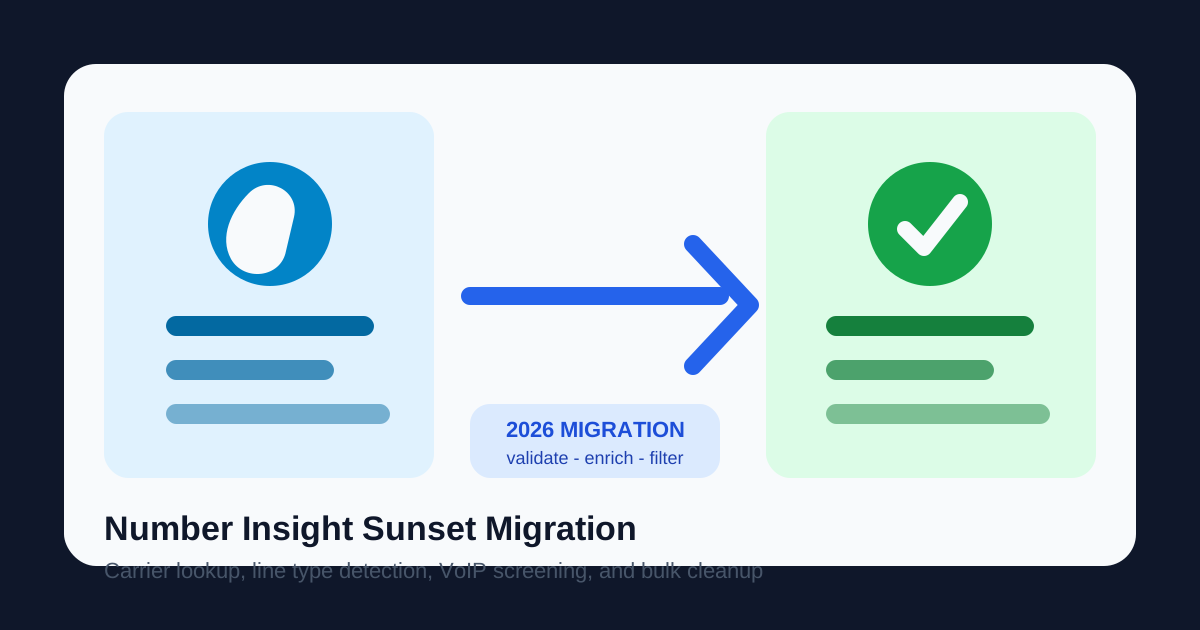
Migration window
Start field mapping and parallel testing in 2026.
Decision fields
Validity, line type, carrier, country, and timezone.
Bulk cleanup
Clean CSV files before SMS platforms receive them.
Featured Snippet Answer
To migrate from Vonage Number Insight, inventory every lookup, map legacy fields to business decisions, test Phone-Check.app in parallel, replace real-time form checks, update bulk CSV validation, and store suppression reasons for invalid, landline, VoIP, disposable, and unknown numbers.
Why This Is a 2026 Migration Topic
Live competitor research shows where the phone intelligence category is moving. Twilio Lookup v2 packages line type intelligence, line status, reassigned number checks, SIM swap, identity match, and SMS pumping risk as separate decision signals. Telesign frames phone intelligence around risk scores, reason codes, IRSF detection, and traffic patterns. AbstractAPI positions phone validation around valid status, risk score, carrier, line type, geographic data, and bulk processing. Buyers are not searching only for a phone parser anymore. They want a row-level decision engine for contact quality.
The Vonage sunset raises a practical question: which parts of Number Insight were product-critical, and which parts were just old integration habit? Marketing teams usually need a reliable answer to four questions before a send: is the number valid, can this channel reach it, which carrier owns the route, and what local context should shape timing? Fraud teams add another layer: is the number disposable, virtual, recently suspicious, or mismatched with the signup context?
Phone-Check.app is a strong fit when the migration target is phone validation, carrier lookup, line type detection, VoIP and disposable screening, timezone enrichment, and bulk list cleanup. If a workflow depends on identity-match claims, keep that requirement separate and document it explicitly. That distinction keeps the migration honest and prevents a messy one-provider-to-another field copy.
Read the Vonage Number Insight sunset noticeField Mapping: Number Insight Need to Phone-Check Decision
| Legacy need | Phone-Check.app field | Business decision | Workflow impact |
|---|---|---|---|
| Format and normalize numbers | number, country, callingCode, nationalNumber | Store one E.164 number per contact | Fewer duplicate records and cleaner API requests |
| Check whether a number is usable | valid | Remove invalid rows before SMS or sales outreach | Lower delivery failure rate and less wasted spend |
| Detect mobile, landline, VoIP, or toll-free | type | Send SMS only to eligible mobile or fixed-line-or-mobile rows | Cleaner channel routing and fewer failed messages |
| Identify network and routing context | carrier, matchedCarriers | Segment by carrier for pacing, reporting, and deliverability checks | Better troubleshooting when one network behaves differently |
| Enrich marketing and support records | geo, timezones | Send by local hour and route regional follow-up | Better engagement and fewer off-hour complaints |
| Screen disposable or virtual numbers | isDisposable, type | Review or suppress risky signups before OTP or promotion abuse | Lower fake signup volume and cleaner funnel analytics |
The Migration Audit Your Team Should Run First
Search the codebase, dashboards, and workflow tools for every old lookup. The obvious call sits inside an API service. The risky ones often live in CSV jobs, Zapier flows, CRM custom code actions, OTP resend checks, and sales operations scripts. Those hidden paths are why a field-by-field audit matters before you change production traffic.
Endpoint inventory
Lookup appears inside signup, checkout, password reset, CRM import, and campaign upload code.
Risk: A partial migration leaves one expensive or fragile path behind.
Action: Create one migration tracker with owners for API, bulk, CRM, fraud, and analytics paths.
Field contract
Old code expects carrier names, line type labels, or null behavior in a specific format.
Risk: Reports shift or suppression rules silently stop matching.
Action: Normalize the new response into explicit internal fields such as phoneLineType and phoneSuppressionReason.
Bulk audience export
Marketing teams still download raw campaign files from the old workflow.
Risk: SMS budget keeps leaking through landlines, invalid rows, and stale imports.
Action: Move CSV uploads to Phone-Check.app and export clean, suppress, and review files.
Fraud and OTP gate
VoIP, disposable, or unknown numbers can still trigger paid OTP sends.
Risk: Attackers exploit the path with the weakest pre-send rule.
Action: Validate before OTP, block invalid rows, and route VoIP or disposable records to review.
Code Example: Replace a Legacy Lookup Gate
The migration should produce a stable internal decision object, not scatter provider response fields across the app. The example below validates a phone number, stores normalized carrier and timezone fields, and returns the action that downstream SMS, sales, or fraud systems should follow.
type PhoneCheckResult = {
  valid: boolean;
  number: string;
  type: "MOBILE" | "FIXED_LINE" | "FIXED_LINE_OR_MOBILE" | "VOIP" | "TOLL_FREE" | null;
  isDisposable: boolean;
  carrier: string | null;
  country: string | null;
  geo: string | null;
  timezones: string[];
};

async function validateForSendDecision(phone: string) {
  const url = new URL("https://api.phone-check.app/v1-get-phone-details");
  url.searchParams.set("phone", phone);

  const response = await fetch(url.toString(), {
    headers: {
      accept: "application/json",
      "x-api-key": process.env.PHONE_CHECK_API_KEY ?? "",
    },
  });

  const result = (await response.json()) as PhoneCheckResult;

  if (!result.valid) {
    return { action: "remove", reason: "invalid_number", result };
  }

  if (result.type === "FIXED_LINE" || result.type === "TOLL_FREE") {
    return { action: "suppress_sms", reason: "not_mobile_sms", result };
  }

  if (result.type === "VOIP" || result.isDisposable) {
    return { action: "review", reason: "virtual_or_disposable", result };
  }

  return {
    action: "send_sms",
    reason: "validated_mobile_candidate",
    carrier: result.carrier,
    timezone: result.timezones[0] ?? null,
    normalizedPhone: result.number,
  };
}
Bulk CSV Migration: Where SMS Savings Usually Appear
Real-time validation protects forms. Bulk validation protects the budget. When a lifecycle team uploads a 600,000-contact campaign file, even a modest invalid rate becomes expensive. If 12% of the file is invalid, stale, disconnected, landline, or otherwise not SMS-ready, 72,000 paid attempts can disappear before creative, offer, or timing quality has a chance to matter.
The safer migration flow is validate, enrich, filter, and export. Upload campaign files to the bulk CSV checker, attach line type, carrier, country, and timezone fields, then download three files: SMS-ready, suppression, and review. That last file matters because not every VoIP or unknown row deserves a permanent block. Some B2B accounts use fixed VoIP numbers and should move to sales review instead of consumer SMS automation.
ROI scenario
A team sending two 500,000-recipient SMS campaigns per month at a blended $0.03 per message spends $30,000 on message attempts. Removing 12% unreachable or non-SMS rows before upload avoids 120,000 monthly attempts, or $3,600 in direct waste. Add landline and VoIP review rules and the total savings can approach the 40% reduction target seen in list-cleaning programs with old CRM imports.
CRM data model
Add phoneValidationStatus, phoneLineType, phoneCarrier, phoneTimezone, and phoneSuppressionReason fields.
Fraud gate
Validate before OTP or promotion sends so disposable, VoIP, and invalid records do not start paid loops.
Marketing routing
Use carrier and timezone data to pace campaigns and send during local windows after the cleanup.
FAQ
When should teams start a Number Insight migration?
Start in 2026, while there is enough time to inventory every lookup, test field mapping, and update bulk cleanup jobs before the February 4, 2027 sunset date published in Vonage documentation.
Can Phone-Check.app replace every identity field from Vonage?
Phone-Check.app is focused on phone validation, carrier lookup, line type detection, portability, geography, timezone, VoIP screening, and bulk list hygiene. If a legacy workflow depends on subscriber identity match, keep that as a separate identity-control requirement.
Should migration work start with API calls or CSV files?
Start with the real-time API path if lookups gate signup, checkout, OTP, or lead routing. Then migrate bulk CSV validation so marketing teams download clean files with the same suppression reasons.
What metrics prove the migration is working?
Track invalid removal rate, landline suppression, VoIP review volume, carrier coverage, timezone fill rate, SMS delivery rate, direct SMS waste, and fraud-review escalations before and after the migration.