B2B Data Enrichment Phone Validation: Verify Mobile Numbers Before Outreach
B2B teams are buying more enrichment, building larger outbound lists, and routing leads faster with AI-assisted workflows. The weak link is not finding another phone number. It is knowing whether that number is current, mobile, safe to contact, and worth putting in front of sales.
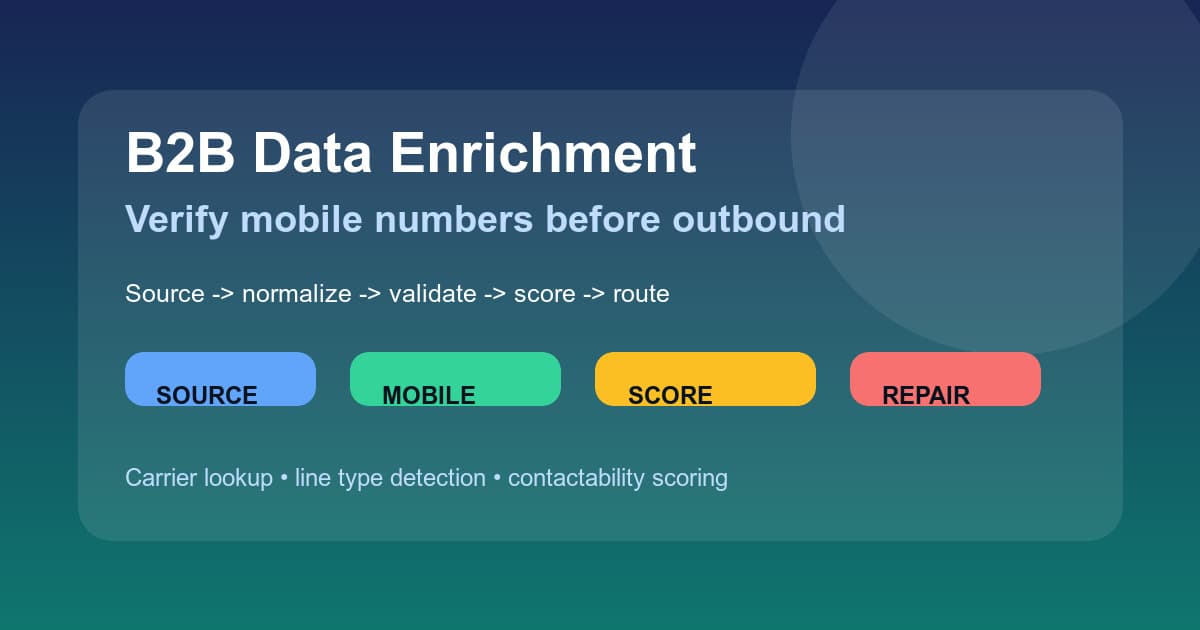
Why Enrichment Needs a Phone Validation Layer
Data enrichment has shifted from a one-time append to a continuous RevOps workflow. Teams combine form fills, webinars, paid leads, partner lists, intent data, CRM history, and third-party contact providers. That creates volume, but volume without validation turns into bad sequences, poor SDR prioritization, and avoidable SMS cost.
Competitor research backs up the shift in search demand. Data-enrichment companies are publishing 2026 guides around waterfall enrichment, first-party data, and verified contact quality. Phone-validation competitors and API vendors are competing for carrier lookup, line type, risk scoring, and phone number verification queries. The gap is the workflow between those worlds: verify enriched phone numbers before they enter outbound.
Phone-Check.app fits that gap by turning a raw phone field into a contactability decision. It returns validation status, carrier, line type, timezone, country, portability, and risk signals across 232 countries with 99.6% accuracy and less than 50ms average response time. Sales teams get fewer unreachable leads. Marketing teams spend less on invalid SMS. RevOps gets a field model that can be audited.
The 2026 Verification Waterfall
Keep source and confidence metadata
Store where the phone number came from, when it was acquired, and whether it came from a vendor, form, enrichment waterfall, event list, or first-party profile.
Normalize before scoring
Convert numbers to E.164, deduplicate across contacts and accounts, and reject malformed records before the lead reaches sales automation.
Validate line type and carrier
Use Phone-Check.app to confirm validity, mobile eligibility, current carrier, country, timezone, portability, VoIP status, and disconnected-number risk.
Calculate a contactability score
Combine phone validation, consent, persona, account fit, source quality, and recent activity into one score that sales and marketing can understand.
Route by next best channel
Send valid mobile records to SMS or SDR sequences, move landlines to voice or email, route risky VoIP to review, and keep invalid records out of paid outreach.
Raw Phone Data vs Verified Contactability
A provider can deliver a direct dial, but the sales system still needs channel context. A mobile number that is valid today deserves a different action from a landline, a non-fixed VoIP line, a disconnected number, or an unvalidated append. The table below is the operating model we recommend for growth teams.
| Phone State | Validation Signal | Risk to Revenue Teams | Outbound Action |
|---|---|---|---|
| Raw enriched phone | No current validation | The number may be stale, malformed, non-mobile, duplicated, or copied from another person at the account. | Hold until verified. |
| Verified mobile | Valid, mobile, carrier returned, timezone returned | Good fit for SMS follow-up, SDR call timing, and account-level routing. | Send to sequence with local-time pacing. |
| Landline / fixed_line | Valid number, non-mobile line type | Calling may be useful, but SMS spend is likely wasted. | Suppress from SMS and route to voice or email. |
| Non-fixed VoIP | VoIP with weaker identity signal | Higher fake signup, low-intent lead, and SMS pumping exposure. | Review, step up, or use non-SMS channels. |
| Invalid or disconnected | Invalid, void, disconnected, or malformed | Direct waste for SMS and a poor use of SDR capacity. | Suppress and send to data repair. |
Build a Contactability Score Sales Will Trust
Sales teams ignore scores they cannot explain. Keep the model simple enough to defend in a pipeline review. Start with account fit, then use phone validation to answer one practical question: should this record receive SMS, a sales call, a slower nurture path, or a data repair task?
Valid mobile line type
+35The contact can receive SMS and supports fast SDR follow-up.
Carrier and timezone present
+15The record can be routed, paced, and measured by network or region.
Recent first-party source
+20A form, checkout, demo request, or event scan beats an old vendor append.
Non-fixed VoIP or disposable
-30The number carries higher abuse risk and weaker contact confidence.
Invalid, landline for SMS, or disconnected
-100The record should not enter paid SMS or high-priority SDR work.
API Example: Score Enriched Leads Before They Hit Outreach
This example assumes enrichment already supplied a phone number. Phone validation then decides whether the lead should enter SMS, SDR follow-up, or repair. In production, run the validation server-side and write the result back to Salesforce, HubSpot, your warehouse, or the sequencing platform.
type EnrichedLead = {
  phone: string;
  source: "form" | "webinar" | "vendor" | "partner" | "crm";
  accountFit: number;
  consentForSms: boolean;
};

type PhoneCheckResult = {
  is_valid: boolean;
  line_type: "mobile" | "fixed_line" | "voip" | "toll_free" | "unknown";
  carrier?: string;
  timezone?: string;
  risk_score?: number;
};

function scoreOutboundContact(lead: EnrichedLead, phone: PhoneCheckResult) {
  let score = lead.accountFit;

  if (phone.is_valid && phone.line_type === "mobile") score += 35;
  if (phone.carrier && phone.timezone) score += 15;
  if (lead.source === "form" || lead.source === "webinar") score += 20;
  if (phone.line_type === "voip" || (phone.risk_score ?? 0) >= 70) score -= 30;
  if (!phone.is_valid || phone.line_type === "fixed_line") score -= 100;

  return {
    score,
    next_channel: score >= 75 && lead.consentForSms ? "sms_plus_sdr" : score >= 45 ? "sdr_call" : "repair",
  };
}
Where This Workflow Pays Off
The first win is obvious: do not send paid SMS to invalid, landline, disconnected, or high-risk numbers. The larger win is operational. Reps stop arguing with the CRM. Demand gen can compare lead sources by reachable mobile rate, not just form volume. Finance can estimate waste before a campaign starts. Security can spot VoIP clusters before fake signups become an OTP bill.
A practical outbound model uses four destinations. Valid mobile records with consent can enter SMS-assisted sequences. Valid landlines move to voice or email. Non-fixed VoIP and high-risk records go to review or lower trust paths. Invalid and disconnected records move to suppression or data repair. That is the same filtering workflow marketers use for bulk SMS campaigns: validate, enrich, filter, remove, and document the reason.
For SDR teams
Prioritize verified mobile numbers and call inside the lead timezone instead of dialing stale records.
For RevOps
Write validation status, line type, carrier, and suppression reason back to the CRM and warehouse.
For growth teams
Cut SMS spend by filtering invalid, landline, and risky VoIP records before automated follow-up.
What to Measure After Launch
Do not stop at match rate. Enrichment vendors often report how many numbers they found. Revenue teams should report how many numbers became usable. Track mobile-ready rate, invalid rate, landline rate, VoIP review rate, carrier coverage, timezone fill rate, connect rate, SMS delivery rate, and revenue per reachable contact.
That last metric matters. A source with fewer raw phone numbers may outperform a larger source if its verified mobile rate is higher. Once phone validation fields are stored, you can compare Google Ads leads, partner imports, webinar scans, outbound databases, and first-party forms on the same quality standard.
FAQ
Why validate B2B enriched phone numbers if the data provider already verifies them?
Provider confidence can be useful, but outbound teams need current channel eligibility. Phone validation checks line type, carrier, timezone, validity, and risk at the moment you plan to use the number, which is different from trusting an old enrichment timestamp.
What is a contactability score?
A contactability score ranks how likely a lead is to be reached through the selected channel. For phone-led outreach, it should combine validation status, line type, carrier, timezone, consent, account fit, source freshness, and risk signals.
Should sales teams call every valid phone number?
No. A valid number means the number is usable, not that the lead is worth immediate human effort. Pair phone validation with account fit, intent, consent, and stage so reps spend time on reachable buyers with real commercial value.
Can phone validation reduce SMS and sales development costs at the same time?
Yes. The same validation fields suppress wasted SMS sends and prevent SDRs from chasing unreachable or risky records. Teams usually see the cleanest ROI when validation runs before both automated messages and human follow-up.
Related Phone-Check.app Guides
Verify enriched phone numbers before sales spends time
Use Phone-Check.app to score, route, and suppress enriched numbers before they reach SMS campaigns, SDR queues, or account-based outbound workflows.