SMS Pumping Risk Score vs Phone Validation Filters: 2026 Prevention Playbook
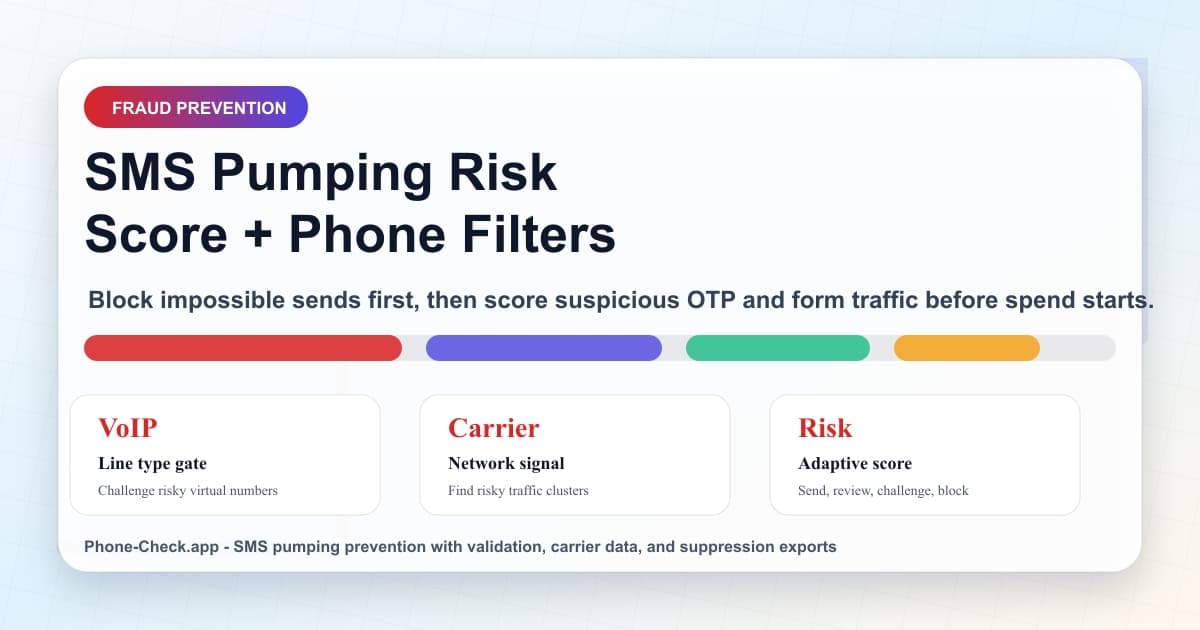
SMS pumping prevention fails when every request gets treated like a normal OTP. The stronger pattern is to filter what is impossible first, score what remains, and stop risky requests before a carrier bills for the next message segment.
Quick answer: risk score or phone filter?
Use both. A phone validation filter decides whether a number is eligible for SMS at all. An SMS pumping risk score decides whether the current request looks abusive. Filtering invalid, landline, disconnected, and risky VoIP numbers first makes the risk score cleaner and reduces paid fraud attempts before scoring even begins.
Fraud reduction target from layered phone risk controls.
SMS waste removed when bad destinations are filtered early.
Real-time phone decision before OTP or form submission.
Delivery target after mobile-ready segmentation.
Why this topic is rising in 2026
Competitor positioning has moved from simple lookup to richer phone intelligence. Twilio now markets Lookup fields for line type intelligence and SMS pumping risk, IPQualityScore documents phone validation responses with fraud and SMS pumping fields, and Telesign positions Phone ID around phone number intelligence and fraud signals. The common message is clear: SMS and OTP programs need a risk decision before they send.
The missing piece for many growth teams is workflow clarity. A risk score sounds sophisticated, but it cannot clean a CSV file, remove landlines before a campaign, or explain why a submitted phone number is not eligible for OTP. Phone validation provides those deterministic fields. Risk scoring decides what to do when the number is technically valid but the request still looks suspicious.
In practice, your fraud and marketing teams should share the same sequence: validate, detect line type, check carrier, identify timezone, filter invalid and risky numbers, then score the transaction. That sequence helps signup forms, checkout pages, SMS campaigns, and sales workflows make consistent decisions.
SMS pumping risk score vs phone validation filters
| Dimension | Phone validation filter | SMS pumping risk score | Stronger combined rule |
|---|---|---|---|
| Primary question | Can this number receive the message, and is it the right line type? | How likely is this request to be abusive based on known risk signals? | Block impossible sends first, then score the remaining requests for abuse. |
| Best signals | Validity, carrier, line type, connectivity, country, timezone, disposable or VoIP status. | Velocity, risky carrier patterns, low conversion patterns, attack history, country and behavior mismatch. | Use phone intelligence as stable input and risk scoring as the adaptive layer. |
| Decision speed | Deterministic result in under 50ms for signup, checkout, and OTP forms. | Fast enough for inline decisions when the scoring service is available and calibrated. | Return a clear allow, review, challenge, or block result before the SMS is sent. |
| Failure mode | May miss coordinated abuse if every phone number looks individually valid. | May overreact without line type, carrier, or deliverability context. | Layer rules so one weak signal does not decide the entire transaction alone. |
A five-layer prevention workflow
Signal: Valid number, normalized format, country allowed, consent context present
Action: Reject malformed or missing phone data before a verification request is created.
Signal: Mobile, landline, fixed VoIP, non-fixed VoIP, toll-free, carrier, and portability
Action: Allow mobile, review fixed VoIP for B2B, and suppress non-fixed VoIP or landlines for OTP.
Signal: Phone country, IP country, account country, and local time
Action: Add friction when the request geography does not match the signup or order context.
Signal: Repeated requests, carrier clustering, high-risk countries, failed conversion loops
Action: Challenge, rate limit, or block suspicious requests before the next SMS segment is billed.
Signal: Rejected rows, chargeback patterns, repeated 30005 or 30006 failures, high-risk outcomes
Action: Export suppression files and update CRM, checkout, and marketing automation rules.
API example: combine validation and request risk
Keep the first decision deterministic. If the number is invalid, a landline, or not SMS-capable, block or reroute it. Score the request only after the phone number passes that eligibility gate.
type PhoneValidation = {
  carrier?: string;
  country_code?: string;
  line_type?: 'mobile' | 'landline' | 'fixed_voip' | 'non_fixed_voip' | 'toll_free';
  risk_score?: number;
  valid: boolean;
};

type RequestContext = {
  attemptsLastHour: number;
  emailAgeDays?: number;
  ipCountry?: string;
  orderValueUsd?: number;
  phoneCountry?: string;
};

type SmsRiskDecision = 'send' | 'challenge' | 'review' | 'block';

export function decideSmsRequest(phone: PhoneValidation, context: RequestContext): SmsRiskDecision {
  if (!phone.valid) return 'block';

  if (phone.line_type === 'landline' || phone.line_type === 'toll_free') {
    return 'block';
  }

  if (phone.line_type === 'non_fixed_voip') {
    return context.orderValueUsd && context.orderValueUsd > 500 ? 'review' : 'challenge';
  }

  let score = phone.risk_score ?? 0;

  if (context.attemptsLastHour >= 5) score += 30;
  if (context.ipCountry && context.phoneCountry && context.ipCountry !== context.phoneCountry) score += 20;
  if ((context.emailAgeDays ?? 30) < 2) score += 15;

  if (score >= 80) return 'block';
  if (score >= 60) return 'review';
  if (score >= 40) return 'challenge';

  return 'send';
}
The thresholds should match your risk tolerance. A fintech OTP flow may challenge earlier than a newsletter signup, while an enterprise checkout may send high-value edge cases to manual review instead of blocking.
Bulk suppression keeps fraud from returning
SMS pumping defense is not only an inline API decision. Export rejected and reviewed numbers from signup, checkout, and campaign workflows, then feed those suppression decisions back into the CRM and bulk checker. That stops bad rows from resurfacing through partner uploads or old campaign files.
Validate bulk filesphone,valid,line_type,carrier,risk_score,decision,suppression_reason
+13125550121,true,mobile,T-Mobile,18,send,
+13125550122,true,non_fixed_voip,Virtual Carrier,62,challenge,voip_velocity
+13125550123,false,unknown,,95,block,invalid_number
+13125550124,true,landline,Local Exchange,10,block,not_sms_capable
+442071234567,true,mobile,EE,84,block,country_velocity_spikeWhat to do with each line type
Mobile numbers with normal velocity should pass. Landlines and toll-free records should leave OTP and SMS marketing flows. Non-fixed VoIP should be challenged or blocked in consumer forms because those numbers are easy to create in volume. Fixed VoIP deserves more nuance in B2B workflows, especially when the account value is high and email, domain, or firmographic signals look legitimate.
Carrier and country fields then help you find clusters. If several blocked requests point to the same carrier, country, form source, and short time window, you have more than a bad number problem. You have a campaign, form, or OTP endpoint that needs rate limits and suppression rules.
Operational rule: do not let a risk score make the first SMS eligibility decision. Validate the phone number first, then score the request.
Common implementation mistakes
Scoring before validation
This wastes scoring capacity on numbers that should have been rejected by validity, line type, or carrier checks.
Treating fixed and non-fixed VoIP the same
Business VoIP and disposable virtual numbers have different risk profiles. Separate them in your routing rules.
Ignoring timezone and geography
A valid number can still be suspicious when country, IP, and local time do not match the signup story.
Failing to export suppression decisions
If rejected numbers stay only in logs, they will return through the next CSV upload or automation sync.
FAQ
Is an SMS pumping risk score enough by itself?
Not for most teams. A risk score helps with adaptive abuse patterns, but deterministic phone validation catches waste a score should not need to infer: invalid numbers, landlines, disconnected rows, non-fixed VoIP, and unsupported countries.
Should I block every VoIP number to prevent SMS pumping?
Block or challenge non-fixed VoIP for consumer OTP and order forms. Fixed VoIP can belong to legitimate businesses, so B2B teams often route it to review or email-first verification instead of suppressing it automatically.
Where should phone validation run in an OTP flow?
Run it before the OTP send request. The system should classify the phone number, decide whether SMS is allowed, and store the decision before your messaging provider bills for the first verification message.
How does bulk validation help with SMS pumping prevention?
Bulk validation removes stale and risky numbers from marketing lists, CRM imports, and suppression files. It also gives fraud teams a review queue of repeated non-fixed VoIP, high-risk carrier, and disconnected-number patterns.
Related reading
SMS Traffic Pumping Detection: Multi-Layer API Defense
Build layered defenses for OTP abuse, carrier fraud, and artificial traffic inflation.
Phone Number Risk Assessment for Lead Validation
Score leads with phone validation, carrier data, line type, and fraud risk signals.
Premium Rate Number Detection for SMS Toll Fraud
Stop high-cost destinations and toll fraud before messages leave your application.